
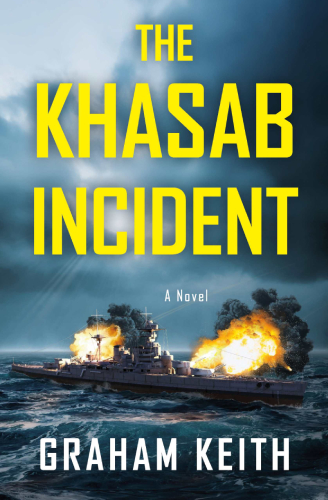

While some books linger, others amuse. Long after the last page, they continue to linger in your mind, posing queries, arousing sympathy, and leaving subdued echoes of comprehension. Stories that provoke thought rather than just impart information are the most memorable. These kinds of books are at the core of thought-provoking fiction, which is literature that questions, enlightens, and unveils new facets of the human condition.
The Khasab Incident by Graham Keith is a good example of this tradition. Written for readers who are as hungry for meaning as they are for story, it is a book of conscience and consequences. It explores not just what people do but also why they do it and the consequences of their decisions, much like other works of thought-provoking fiction.
Why Readers Seek Thought-Provoking Fiction
Reflective storytelling provides something uncommon in a time of rapid-fire content and short attention spans: calm. Readers can slow down and delve deeply into concepts, feelings, and moral complexity when they read thought-provoking fiction. It serves as a reminder that good fiction is exploration rather than escape.
This type of literature appeals to readers who are looking for truth rather than heroes or villains. They aspire to enter the heads of flawed, conflicted characters and come out on the other side transformed. Such stories frequently raise uncomfortable questions, but it is precisely this discomfort that gives them their transformative power.
That audience is exactly what Keith’s writing targets. His writing is thoughtful, reflective, and emotionally astute. He makes every moral quandary feel both personal and universal by allowing tension and ambiguity to breathe rather than hurrying towards resolution.
The Beauty of Intellectual Emotion
The way that thought-provoking fiction strikes a balance between intellect and emotion is one of its greatest advantages. The best stories evoke rather than preach. They help us feel our way to comprehension.
This art has long been displayed by writers like Ian McEwan, Marilynne Robinson, and Graham Greene: crafting stories in which philosophical contemplation and emotional depth coexist. Graham Keith carries on that tradition by writing tales that compel readers to consider moral limits, forgiveness, and faith.
Emotion and ethics are intertwined in the Khasab Incident. The characters in the book battle not just with conflict outside of themselves but also with the inner turmoil of their own beliefs. Keith demonstrates via their journey how contemplation can result in atonement and how thinking itself can be a brave act.
Fiction as a Mirror
Fundamentally, provocative fiction acts as a mirror. It forces us to examine ourselves by reflecting back to us our own doubts. It challenges us to examine the morals we take for granted and the narratives we tell ourselves about right and wrong.
This kind of introspection is exactly what Keith’s story encourages. His protagonist, torn between obligation and morality, serves as a vehicle for examining the challenging realities of human nature. Every chapter turns into an appeal for empathy, not the sentimental kind, but the kind that necessitates reflection.
In this way, Keith’s writing is experienced rather than merely read. It forces the reader to participate both intellectually and emotionally, fusing comprehension and emotion in a way that makes literature enduring.
The Enduring Value of Quiet Fiction
The literary world of today frequently extols speed and spectacle. However, there is great power in self-control, in silent stories that develop through dialogue, moral tension, and memory. Fiction that provokes thought flourishes in that nuanced area.
Keith’s storytelling is a prime example of that craft. His pacing is deliberate but captivating, and his language is elegant but unpretentious. He demonstrates that truth, not noise, is all that a novel needs to keep our interest. His words create an experience that feels both timeless and urgently relevant by encouraging reflection rather than distraction.
This is the kind of fiction that is meant to be read again and again with a deeper comprehension each time, rather than being consumed quickly.
The Moral Weight of Reflection
True reflection always carries moral weight. Thought-provoking fiction leaves readers with more than closure; it leaves them with questions. What do we owe to others? How far should duty stretch before it becomes a compromise? Can forgiveness ever erase guilt?
Keith’s The Khasab Incident engages with these questions fearlessly. It presents human frailty not as failure but as fact; an inherent part of existence. His characters do not find easy redemption, yet through their introspection, they discover truth.
That truth, messy, human, and compassionate; is what makes Keith’s work resonate so deeply.
Final Thoughts
The best literature whispers its message rather than shouting it. Because it honors the reader’s intelligence, thought-provoking fiction has great power. It has faith in our ability to grow, question, and discover meaning.
This uncommon form of narrative is best represented by Graham Keith’s The Khasab Incident, which is emotionally honest, morally insightful, and full of introspection. It is fiction for readers who wish to think, feel, and gain a slightly clearer understanding of the world.